
Gas Bill Calculator — Sui Gas Bill Calculator for SNGPL & SSGC (2026)
Last verified: July 23, 2026 · Reviewed against public OGRA, SNGPL, and SSGC tariff pages · This tool gives an estimate. Your official bill can still differ, and we explain exactly why below.
Your gas bill can feel like a mystery. One month it is normal. The next month it jumps, even though you swear you used the same amount of gas. This gas bill calculator helps you understand your bill before it arrives, so you are never caught off guard again.
This page is a full sui gas bill calculator for both major gas companies in Pakistan: SNGPL (Sui Northern Gas Pipelines Limited) and SSGC (Sui Southern Gas Company). Whether you live in Lahore, Rawalpindi, Islamabad, Peshawar, Multan, or Karachi, Hyderabad, Sukkur, and Quetta, you can use this tool to get a real answer for your area.
We built this gas bill calculator pakistan tool because most calculators online only show you a number. They do not tell you why that number is what it is. We do both.
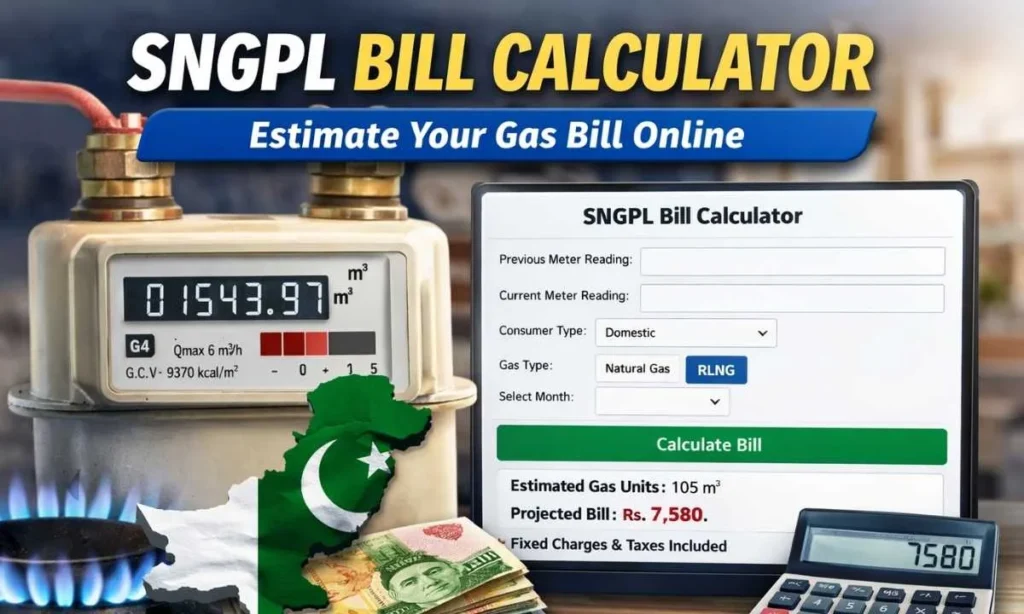
Gas bill calculator
Estimate your SNGPL and SSGC gas bill using the same progressive slabs as SNGPL and SSGC own Bill Estimator.
Both numbers are printed on your gas meter dial, or on last month’s bill.
SNGPL classifies domestic consumers as protected up to 0.90 Hm³ per month, non-protected above it. This calculator applies the matching slab automatically.
Slab rates, fixed charges, and the progressive slab rule are taken directly from SNGPL’s official Bill Estimator. The Hm³-to-MMBTU conversion formula is not published by SNGPL itself; this calculator uses a widely-cited approximation. Your official category is set by your average usage across the 4 winter months (Nov-Feb) and reviewed periodically, so a single month’s reading here is an estimate, not your confirmed category. Confirm the final figure on your official SNGPL bill.
How This Gas Bill Calculator Sngpl & Ssgc Tool Works
You do not need to be good at math to use this. Just follow these steps:
- Pick your gas company. Choose SNGPL if you live in Punjab, Khyber Pakhtunkhwa, Islamabad, or Azad Jammu & Kashmir. Choose SSGC if you live in Sindh or Balochistan.
- Enter your meter readings. Look at the black digits on your gas meter. Write down your previous reading (from your last bill) and your current reading (from today).
- Tell us your category. Are you a Protected consumer or a Non-Protected consumer? If you are not sure, check your last bill — it is printed there. We also explain how to figure this out below.
- Get your estimate. The calculator subtracts your previous reading from your current reading, converts the result into energy units, and applies the correct government slab rate.
This is the same basic method both SNGPL and SSGC use internally, just explained in plain words.
Sngpl Gas Bill Calculator: What Makes It Different From Ssgc
People often ask, "isn't it all the same math?" Not exactly. SNGPL and SSGC use different slab structures, different fixed charges in some cases, and different regional Gas Calorific Value (GCV) numbers. A sui northern gas bill calculator and a sui southern gas bill calculator should never share the exact same table, even though many tools online sloppily copy one table for both. We keep them separate so your estimate is closer to your real bill.
Read More
The Real Formula Behind Every Sui Gas Bill
This is the part most websites skip. Here is exactly how your gas bill is built, step by step, in the same order the gas companies use.
- Step 1 — Units used: Current meter reading minus previous meter reading. This gives you cubic meters (m³) of gas used.
- Step 2 — Convert to Hm³: Divide your units by 100. This turns cubic meters into Hm³ (Hecto Cubic Meters), the unit gas companies use for billing. For example, 113 m³ becomes 1.13 Hm³.
- Step 3 — Apply the Pressure Correction Factor (PCF): Gas pressure is not exactly the same everywhere. The PCF adjusts your reading to a standard pressure so billing stays fair across regions. This gives you Standard Cubic Meters (SCM).
- Step 4 — Convert to MMBTU using GCV: Gas is not billed by volume alone — it is billed by energy. The Gas Calorific Value (GCV), printed on your bill, tells you how much energy is in your gas. Multiply your Hm³ by the GCV and divide by 281.7358 to get MMBTU (Million British Thermal Units). This is the number your bill is actually priced on.
- Step 5 — Apply the slab rate: Every MMBTU falls into a slab. Each slab has its own rate per MMBTU, set by OGRA (the Oil and Gas Regulatory Authority). Lower slabs cost less per unit; higher slabs cost more.
- Step 6 — Add the fixed parts: Meter rent, a fixed monthly charge, and 18% GST get added on top of your gas charges.
Once you understand these six steps, your bill stops looking like a random number and starts looking like simple math.
Protected Vs Non-Protected: Why This One Word Decides Your Whole Bill
This is the single biggest reason two neighbours with almost the same usage can pay very different amounts.
- Protected consumers pay a lower fixed charge, around Rs. 600 per month, plus lower slab rates.
- Non-Protected consumers pay a higher fixed charge — Rs. 1,500 if usage stays under 1.5 Hm³, and up to Rs. 3,000 if usage goes above that — plus higher slab rates.
Here is the part almost nobody explains clearly: your category is not decided by this month's usage. It is decided by your average gas usage during the four winter months — November, December, January, and February. If that average stays at or below 0.9 Hm³, you are Protected for the rest of the year. If it goes above 0.9 Hm³, you become Non-Protected — and you stay Non-Protected even in summer, when you barely use any gas.
This is why so many people search for help with a gas bill estimate calculator in July and August. They see a high bill, low usage, and no clear reason why. The reason is almost always this rule.
Real example: A household uses slightly more gas than usual in January because of a cold spell — maybe running the heater a bit longer. Their four-month winter average comes out to 0.95 Hm³, just above the 0.9 Hm³ line. That single winter pushes them into Non-Protected status for the entire year, even though every other month looks completely normal.
Rlng Gas Bill Calculator: Why Some Bills Are Higher Even With The Same Usage
Another reason bills rise without warning is RLNG — Re-gasified Liquefied Natural Gas. Pakistan's local gas supply cannot meet full demand, so it gets blended with imported RLNG. RLNG has a different, usually higher, cost per MMBTU than local gas. When your area gets a higher share of RLNG in the blend, your bill goes up even if your meter reading barely moves.
This is why an accurate rlng gas bill calculator needs to account for blend ratio and region, not just slab rate. Most basic tools ignore this completely.
Gas Bill Calculator Sngpl Slabs Vs Ssgc Slabs (2026)
| Category | SNGPL Structure | SSGC Structure |
|---|---|---|
| Protected | Slab tiers up to 0.9 Hm³, fixed charge around Rs. 600 | Four slab tiers (0.25 / 0.5 / 0.6 / 0.9 Hm³), fixed charge around Rs. 600 |
| Non-Protected | Slabs rising in stages above 0.9 Hm³, fixed charge Rs. 1,500–3,000 | Eight slab tiers (0.25 up to above 4 Hm³), fixed charge Rs. 1,500–3,000 |
| GST | 18% | 18% |
| Extra factors | RLNG blend surcharge, regional GCV | Pressure factor, regional GCV |
Exact rupee-per-MMBTU rates change whenever OGRA issues a new notification, sometimes more than once a year. Always compare our estimate against your latest bill, since a single notification can shift rates by a large percentage overnight.
Common Problems People Face With Their Sui Gas Bill (And What To Do)
These are the real problems people talk about online — on Reddit, on Facebook groups, and in complaint forums. If one of these sounds like you, you are not alone.
- "My own math doesn't match my bill." This is one of the most common complaints. Usually, the gap comes from the Pressure Correction Factor or a GCV that changed slightly from last month. Check the GCV number printed on your latest bill before assuming it is a mistake.
- "My bill jumped even though I used less gas." This almost always points back to the Protected/Non-Protected rule explained above, or an RLNG blend change.
- "I think my meter is faulty or stuck." If your reading has not moved for two or more billing cycles despite normal usage, request a meter test from your nearest SNGPL or SSGC office.
- "There's an old unpaid amount stuck on my new bill." This is called an arrear. It carries forward until it is paid, so a summer bill can still look high because of a winter balance from months ago.
- "I don't know if I'm Protected or Non-Protected." Look at your last physical bill. The category is printed clearly near the tariff section.
- "I want to complain, but I don't know how." Call the helpline at 1199, visit your nearest Customer Facilitation Center with your CNIC and old bill, or use the official online complaint form. Keep your complaint reference number to track progress.
How To Lower Your Sui Gas Bill
Small habits make a real difference, especially in winter when slab jumps hurt the most.
- Use an instant geyser instead of a storage/tank geyser — instant geysers burn far less gas.
- Turn the geyser off between uses instead of letting it run all day.
- Fix small leaks at pipe joints and stove connections right away — a tiny leak wastes gas every single hour, all month long.
- Try to keep your winter average at or under 0.9 Hm³ across November to February, since this single number decides your entire year's category.
- Check your bill every month for arrears or a rebate adjustment, so a mistake never quietly repeats itself.
Local Factors That Change Your Bill By Region
Your city affects your bill more than most people realize.
- Northern Pakistan (SNGPL area): Lahore, Rawalpindi, Islamabad, Peshawar, Multan, Faisalabad, Abbottabad, and nearby cities see the biggest winter swings, because cold weather drives heavy heater and geyser use for months at a time.
- Southern Pakistan (SSGC area): Karachi, Hyderabad, Sukkur, and Quetta usually see smaller winter swings but a heavier mix of commercial and industrial gas use, especially in Karachi.
- Load management schedules (when gas pressure is reduced at certain hours) are common in winter across both networks and can affect how efficiently your appliances use gas, which shows up on your bill.
- GCV varies by region and by month. It is printed on the top-right section of your bill, so always check it rather than assuming last month's number still applies.
Frequently Asked Questions
How do I calculate my gas bill myself?
Subtract your previous meter reading from your current reading to get units used. Divide by 100 to get Hm³. Multiply by your bill's GCV and divide by 281.7358 to get MMBTU. Apply the correct slab rate for your category, then add meter rent, fixed charges, and 18% GST.
What is the rate of Sui gas per unit in 2026?
There is no single fixed rate. The rate depends on your slab, your Protected or Non-Protected category, and the region's GCV. OGRA updates these rates through official notifications, sometimes more than once a year, so always check your latest bill or the OGRA website for the current number.
Why is my gas bill high in summer even though I hardly use gas?
Your Protected or Non-Protected category is locked in based on your average usage during the four winter months, not on your current month's usage. If your winter average went above 0.9 Hm³, you stay in the Non-Protected category, with its higher fixed charge, until the next review.
What does HM³ mean on a gas bill?
Hm³ stands for Hecto Cubic Meter, which equals 100 cubic meters. It is the standard volume unit both SNGPL and SSGC use before converting your usage into MMBTU for billing.
How is Protected or Non-Protected status decided?
It is based on your average gas usage across November, December, January, and February. An average at or below 0.9 Hm³ makes you Protected. Above that, you become Non-Protected for the rest of the review cycle.
What is RLNG and why does it affect my bill?
RLNG is imported gas that gets blended with local gas supply. It usually costs more per MMBTU than local gas, so a higher RLNG share in your area's supply can raise your bill even without any extra usage on your part.
What should I do if I think my bill is wrong?
Compare the GCV and meter readings on your bill against your own numbers first. If the gap remains, visit your nearest Customer Facilitation Center with your CNIC and previous bill, or call the helpline at 1199 to request a review or a meter test.
About this guide
This page is reviewed and updated whenever OGRA, SNGPL, or SSGC issue a new tariff notification. Figures are checked against public regulatory pages, but your official bill is always the final source of truth. This tool and page are independent and are not affiliated with SNGPL, SSGC, or OGRA.